
Should your private aircraft have flight attendants (FAs) or cabin safety attendants (CSAs)? In our experience, the application and use of these positions are topics of debate in business aviation. To get some real numbers, we posted a LinkedIn poll asking about the range of policies associated with flight attendant usage.
In summary, the results showed us that one-third of organizations use flight attendants all the time, and one-third never use them.
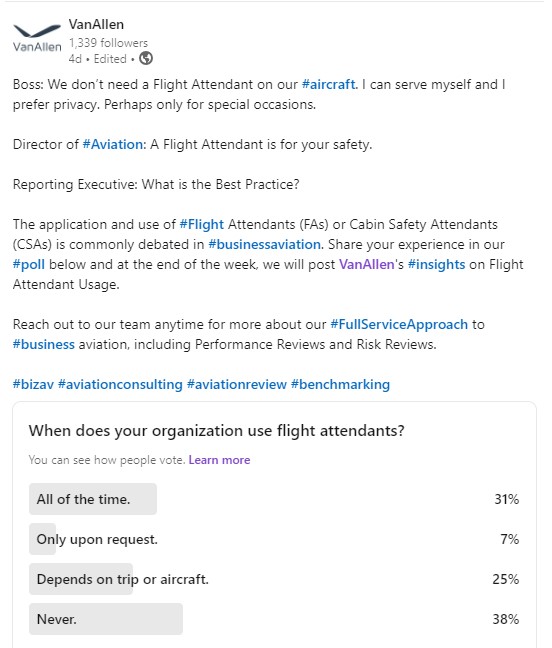
It’s a pretty “all or nothing” approach — but which makes the most sense for your private aircraft program? Do the benefits of having FAs or CSAs outweigh the added costs? That depends not only on who is using the aircraft, but also on how your organization defines its aviation program.
Below, we offer a few policies and strategies summarized as World Class, Best Practices, and FAA Compliance. We recommend aligning your practices with your organization’s appetite for risk. But first, it’s important to understand the actual role and responsibilities of cabin safety attendants.
Cabin Safety Attendant – Roles & Responsibilities
The primary purpose of a CSA is to ensure the safety, security, and well-being of passengers during the flight. They are responsible for implementing and enforcing safety procedures, conducting pre-flight and post-flight cabin briefings and inspections, and providing assistance and guidance to passengers in emergencies. CSAs are trained to handle various emergency situations, including rapid decompression, evacuations, and medical emergencies.
Secondarily, the CSA is responsible for passenger service to create a comfortable and productive work environment. This can include meal service, technical support for cabin entertainment and Wi-Fi, and coordination with the flight crew on any route changes.
Policy #1: World Class
If your organization wants to present your aviation program as a world-class operation, then it’s your responsibility to showcase a heavy focus on safety, to offer personalized service, and demonstrate operational efficiency. Accordingly, a world-class operation will need to have a CSA on every single passenger flight, regardless of the number of passengers who are traveling or the length of the flight.
Additionally, key passengers, typically the most common travelers, will have gone through aircraft-specific emergency training in the event the CSA is incapacitated and unable to respond to an emergency egress. This is the highest level of risk mitigation and key to earning world-class-level safety certifications such as the International Standard for Business Aircraft Operations (IS-BAO) or ARGUS Platinum.
Policy #2: Best Practices
If having a CSA on every flight isn’t feasible, then you can still be recognized as a best practices operation by including a CSA on specific flights. Most commonly, this will include:
- Flights with only one passenger, regardless of duration, in the event the sole occupant has a medical emergency
- Any flight with 8 or more passengers
- Any flight over sparsely populated terrain (more than 20 mins from an emergency airport)
- Any oceanic crossing or international flight (outside the contiguous U.S.)
- Any flight with a client/customer on board
In all cases, the most common and/or frequent passengers should have all completed aircraft-specific emergency training.
Policy #3: FAA Compliance
The FAA does not generally require trained CSAs on private business aviation aircraft. As for flight attendants, according to the FAA under Part 91, an FA is only required for any aircraft having more than 19 passengers. This eliminates nearly all business aircraft, as very few models can accommodate more than 19 passengers.
The only exception, at this time, would be the Gulfstream G550. For any G550 passenger load of 10 or more passengers, you will be required to have a crew member trained on evacuation procedures. The pilot and co-pilot cannot serve this function.
For additional resources about this topic, visit the NBAA Safety Committee or the Flight Safety International Cabin Safety Training for crew members or executive passengers.
Want to learn more about identifying and developing policies around unique aviation risks? Read more about our Performance Review and Risk Review services. Or, contact the VanAllen team directly, and we can help you see the full picture and make decisions with confidence.
To get started, contact VanAllen today.
Related Posts


VanAllen Insights – Aircraft Trust: What They Are, When to Use One, & More
Trusts, which are fiduciary arrangements that enable a third party (trustee) to hold assets on behalf of a beneficiary (trustor), are often used for estate planning, property transfer, asset preservation and so on.

VanAllen Insights – Everything You Need to Know About Aircraft Pre-Purchase Inspections
An aircraft pre-purchase inspection, or a pre-buy inspection, refers to the process by which a qualified entity or inspector examines an aircraft during a potential sale or transaction. The inspection aims to identify any pre-existing damage, potential maintenance issues, non-conformity of aircraft records and so on in order to protect the buyer’s interests.